Digital Transformation In Business: How Technology Is Reshaping The Market
The Foundations of Digital Transformation
At its core, digital transformation in business refers to the integration of digital technologies into all areas of a business, fundamentally changing how value is delivered to customers and how operations are managed internally. This process is not limited to simply adopting new software or tools; it is about creating a culture of agility, adaptability, and innovation.
For many businesses, this means replacing outdated legacy systems with cloud-based solutions, automating manual processes, and using data-driven insights to make more informed decisions. Importantly, digital transformation is also about people: employees must be equipped with the skills needed to thrive in a digitally enhanced workplace. Without this cultural and human element, technology alone cannot achieve lasting results.
Digital Transformation in Business: The Driving Forces
Several factors are accelerating digital change. Consumer behaviour is shifting rapidly, with customers expecting seamless digital experiences across platforms, from online shopping to personalised customer service. Businesses that fail to meet these expectations risk losing relevance.
In addition, competition has intensified as technology lowers barriers to entry, allowing new players to disrupt established markets. Global events such as the COVID-19 pandemic have also reinforced the need for digital resilience, forcing companies to adopt remote work, digital collaboration, and online sales models almost overnight.
Another major driver is government and institutional support for digital adoption, particularly in areas like research and development, artificial intelligence, and sustainability-focused technologies. Collectively, these forces are ensuring that digital transformation in business is no longer optional but essential.
Numbers That Define Digital Transformation
The scale and impact of digital transformation can be better understood through the combination of figures and trends that are reshaping today’s market:
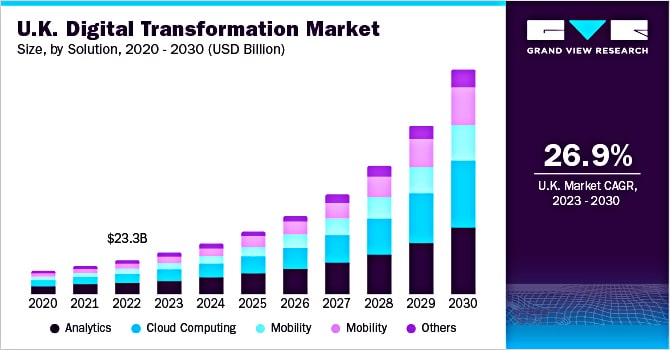
Annual investment in digital transformation reached £27 billion in 2024, a clear sign of its priority on corporate agendas.
Around 50% of companies have already moved to cloud-based solutions, improving flexibility and efficiency.
Nearly 35% of businesses report using AI tools to enhance operations, from automating customer service to analysing data patterns.
The digital economy contributes approximately £150 billion annually to GDP, highlighting its central role in economic growth.
About 40% of firms experienced a cybersecurity breach in the past year, underlining the importance of digital security strategies.
By 2030, 11 million workers will need digital upskilling to remain competitive in the labour market.
More than 85,000 digital and tech companies are operating nationwide, strengthening the country’s position as a global innovation hub.
These figures demonstrate not only the rapid pace of technological adoption but also the opportunities and risks that come with it.
Growth Statistics Of Digital Transformation in Business
Opportunities of a Digital-First Future
While challenges exist, the opportunities that come with digital transformation are immense. Businesses that embrace technology are better positioned to deliver personalised customer experiences, streamline operations, and enter new markets.
Artificial intelligence and machine learning, for example, are creating new possibilities in predictive analytics, customer engagement, and product development. Cloud technology allows companies to scale rapidly and cost-effectively, while data-driven decision-making ensures greater accuracy and responsiveness.
Moreover, digital transformation enables greater sustainability. From energy-efficient supply chains to paperless processes, technology is helping businesses reduce their environmental footprint while meeting consumer demand for greener practices. In this sense, digital adoption is not only a competitive advantage but also a pathway to more responsible and future-proof growth.
Continue exploring
Related postgraduate programmes
Compare similar courses and find the programme that best fits your goals.
Develop the skills you need to resolve complex economic issues. You’ll learn about core economic theories and empirical methods, and their real-world uses. During this course, you will explore the connections between the economy, its key sectors (such as businesses, the financial sector and gover...
If you're ready to build on your current knowledge and experience and excited to start or continue your successful career in project management, this MSc Project Management degree is for you. On this Master’s programme you’ll explore the principles, practices, tools and techniques of project ma...
The Economics and Management degree examines issues central to the world we live in. It namely examines how the economy and organisations function, and how resources are allocated and coordinated to achieve the organisation’s objectives. Economics and Management are ideal intellectual partners, e...
Are you an ambitious professional looking to transform yourself, your career and your life? The Manchester Full-time MBA is one of the world's most practical MBAs. You will gain unbeatable experience for your CV by taking on three consultancy projects with real clients. It doesn't get more hands-on...
Modern organisations are increasingly on the lookout for hybrid managers. Individuals that can combine the skill sets of a management consultant and a project manager will always be a first choice candidate. A key element of this programme is a focus on the practical application of management consu...