
MATEMATICA PURA A Distancia, Blended Learning, Videoconferencia
2...
View programmeWelcome to POSTGRADCOURSES — Connecting students with outstanding postgraduate programmes.
Postgraduate study insights
Postgraduate education has grown significantly in recent years, with more students pursuing advanced qualifications to remain competitive in the labour market. The UK has positioned itself as a global hub for postgraduate study, attracting both domestic and international students.
This expansion has been driven by several factors: rising employer expectations, the rapid pace of technological change, and the increased specialisation of industries. Employers now expect graduates not only to hold an undergraduate degree but also to demonstrate advanced skills and adaptability. Postgraduate education therefore provides both credibility and practical competencies that enhance employability.
Within this context, the MSc, MBA, and PGDip stand out as three distinct yet interrelated qualifications. While all represent advanced study, they vary in terms of duration, scope, academic rigour, and career outcomes.
The MSc is designed for students who wish to specialise in a particular academic or technical discipline. It is particularly common in fields such as data science, engineering, finance, environmental studies, and health sciences.
MSc programmes typically run for one to two years full-time, or longer on a part-time basis. They combine taught modules with independent research, culminating in a dissertation. Modules may cover advanced theories, methodologies, and applications within a specific field. For example, an MSc in Data Science might include machine learning, statistical modelling, and big data analytics, alongside a research project applying these methods to real-world problems.
Students gain analytical, problem-solving, and research skills. They also learn to evaluate evidence critically, design experiments, and interpret results. Such competencies are invaluable in both academic and professional settings.
MSc graduates are often employed in technical roles, consultancy, research organisations, or academia. For those wishing to pursue doctoral study, the MSc is usually a prerequisite. It is also highly regarded in industries that rely on specialist knowledge, such as pharmaceuticals, finance, or environmental consultancy.
The MBA is globally recognised as a premier qualification for leadership and management. Unlike the MSc, which emphasises academic depth, the MBA focuses on equipping professionals with strategic and operational skills.
MBA programmes in the UK generally last one year full-time, though part-time, executive, and online options are widely available. The curriculum is broad, covering finance, marketing, operations, human resources, and organisational behaviour. A hallmark of the MBA is its emphasis on case studies, simulations, and group projects, which mirror real-world business challenges.
MBA students develop leadership, decision-making, negotiation, and communication skills. The programmes also foster global awareness, entrepreneurship, and adaptability, preparing graduates for senior roles across industries.
Graduates often move into leadership positions such as directors, consultants, or entrepreneurs. The MBA is particularly valuable for those seeking rapid career progression, industry transitions, or the skills to launch their own ventures. Importantly, MBA programmes offer extensive networking opportunities, connecting students with peers, alumni, and industry leaders worldwide.
The PGDip is often underestimated but represents a versatile and valuable form of postgraduate education. It provides advanced training without the full commitment of a master’s degree.
A PGDip usually lasts six months to one year. It covers many of the same modules as a master’s degree but excludes the dissertation or thesis. This makes it more focused on taught knowledge and professional application.
PGDip students acquire practical and industry-relevant skills, often tailored to specific professional contexts such as education, healthcare, or management. Many programmes are designed in collaboration with employers or professional bodies, ensuring that content aligns with industry needs.
The PGDip is particularly attractive for professionals who wish to upskill quickly or gain credentials recognised within their industry. In some cases, it can serve as a pathway to a full master’s degree, allowing students to “top up” their qualification if they wish to continue their studies later.
The choice between MSc, MBA, and PGDip often depends on practical factors as much as academic interest.
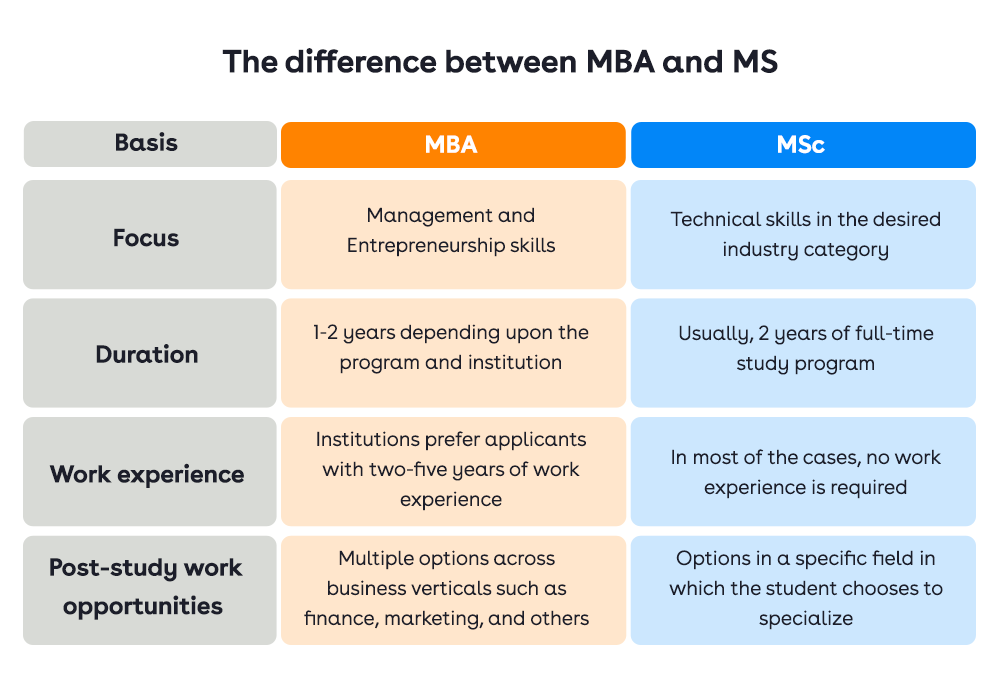
These differences in cost and duration mean that the right choice depends heavily on financial resources, personal circumstances, and career timelines.
Another key distinction is the orientation of each qualification.
Understanding your learning style and professional priorities is therefore essential in determining the most suitable pathway.
To illustrate how these qualifications serve different goals, consider the following profiles:
These examples show how each qualification addresses specific needs, reinforcing the importance of aligning study choices with individual goals.
Employability is a critical factor when choosing a qualification. While salaries vary across industries, data shows that postgraduates consistently earn more and experience lower unemployment rates than those with only undergraduate degrees.
The return on investment, however, is not solely financial. Postgraduate education also enhances confidence, broadens networks, and fosters personal growth.
With so many differences, the decision comes down to personal and professional priorities:
No single option is inherently better; each serves a distinct purpose. The best choice depends on where you are in your career, what you wish to achieve, and how much time and resources you can commit.
Continue exploring

Aimed at ambitious graduates, this practice-based MA course is supported by marketing theory. Staff have broad national and international industry experience which underpins and informs the course. Develop your creative design practice and thinking, while building valuable marketing and business ski...
View programme
Civil engineering is about shaping the built and natural environments in which we live. It is a broad discipline that improves many aspects of our everyday lives, from the provision of safe drinking water to the development of earthquake resistant structures, while also protecting our natural envir...
View programme
Aimed at ambitious graduates, this practice-based MA course is supported by marketing theory. Staff have broad national and international industry experience which underpins and informs the course. Develop your creative design practice and thinking, while building valuable marketing and business ski...
View programme