
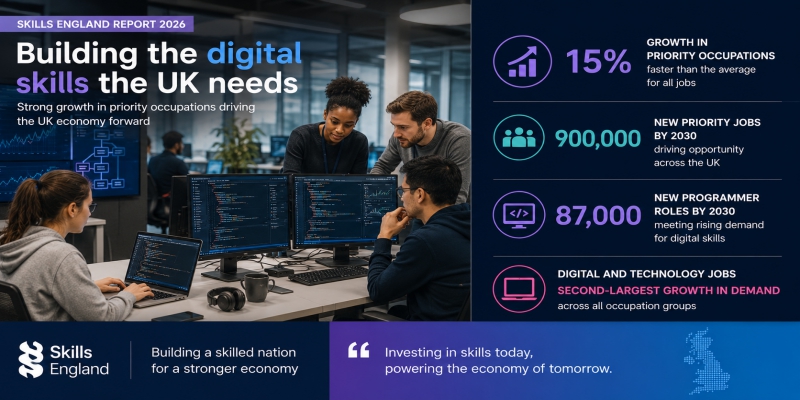
Digital and technology jobs are expected to experience the second-largest growth in demand of any sector in the UK by 2030, according to new projections from Skills England that lay bare the scale of the nation's looming skills challenge.
The findings, published in the government skills body's Assessment of Priority Skills to 2030 report, reveal that employment in priority occupations is expected to grow by 15 per cent between 2025 and 2030, from 5.9 million to 6.7 million roles, significantly outpacing growth in non-priority occupations.
The analysis, described as the first quantitative assessment to look across all ten priority sectors identified in the Government's Industrial Strategy and Plan for Change, identifies Digital and Technologies alongside Adult Social Care, Construction and Engineering as the sectors set to experience the largest increases in workforce demand.
87,000 new roles for programmers and software developers
Within the digital and technology sector, the projections point to particularly strong demand for advanced roles. Programmers and software development professionals top the list of growth occupations, with an estimated 87,000 additional roles expected by 2030.
This level of demand is comparable only to adult social care, where care workers and home carers account for 90,000 additional roles — the highest single occupational increase in the report.
Other digital roles featuring prominently in the projections include IT business analysts, architects and system designers, alongside IT managers and IT directors. Four of the six occupations with the largest additional demand to 2030 are in the digital and technology sector.
Digital skills as a foundation across the economy
The reach of digital occupations extends well beyond the technology sector itself. Programmers are listed as a priority occupation in seven sectors, from advanced manufacturing to financial services, while IT business analysts appear in six sectors.
This pattern highlights the role of digital skills as a foundation for innovation and productivity in industries far beyond technology, with demand for specialists in AI, cyber-security and cloud engineering continuing to outstrip supply.
Advanced skills in highest demand
Unlike adult social care, where most roles require qualifications below Level 4, the digital sector's projected growth is concentrated in advanced roles at Level 4 and above. Two-thirds of the projected extra demand in priority occupations will require workers with qualifications at Level 4 or higher, with one third requiring Level 2 or 3 qualifications.
The report also tracks the main routes into priority occupations through education. In higher education, 70 per cent of computing graduates enter priority roles — higher than engineering graduates (68 per cent) and economics graduates (65 per cent), though lower than nursing and midwifery graduates who have near-total progression rates.
Nearly 900,000 new priority jobs by 2030
Overall, Skills England projects that the UK will need nearly 900,000 more skilled workers across its priority sectors by 2030. Currently, around 285,000 people a year enter priority occupations from government-funded training, with two-thirds qualified at Level 4 and above, broadly matching demand but leaving risks in key sectors.
'A call to action'
Phil Smith, Chair of Skills England, described the findings as a decisive moment for the UK workforce.
"We are entering a decisive period for the UK workforce," Smith said. "These findings make it clear that without targeted, high-quality training and investment, we will not be ready for the jobs of tomorrow. This report is a call to action – for government, employers, educators and training providers to work together to ensure the skills system is ready for the future".
The guidance warns that technological disruption, particularly from artificial intelligence, could reshape the jobs landscape, adding uncertainty to future demand. It calls for ongoing monitoring and flexibility to ensure the skills system can adapt.
Skills England has committed to continuing to refine its methodology and expand future assessments to cover national, sectoral and regional skills needs.
Industry reaction
The National Centre for Universities and Business (NCUB) warned that the growing mismatch between employer needs and available skills is already holding back business performance.
"The growing mismatch between the skills employers need and the skills available in the workforce is already holding back business performance and innovation — and risks derailing the UK's growth ambitions," said Rosalind Gill, NCUB's Director of Policy.
"Universities are ready to bridge this gap. Two-thirds of future jobs will require advanced skills, and with the right investment and policy backing, universities can rapidly scale up agile, mid-level qualifications tailored to adult learners".
A defining moment for the UK workforce
For students, graduates and career-changers across the United Kingdom, the message from Skills England is unambiguous: the jobs of tomorrow will increasingly be in digital and technology roles, and the demand for advanced skills is set to accelerate.
The projections underline the importance of investing in digital skills education, whether through university degrees, degree apprenticeships, technical bootcamps or shorter modular courses. With nearly 900,000 new priority roles expected by 2030 and digital jobs accounting for the second-largest share of that growth, the opportunity for those equipped with the right skills has never been greater.
As Phil Smith put it: "Together, we are building a more skilled and prosperous nation".