
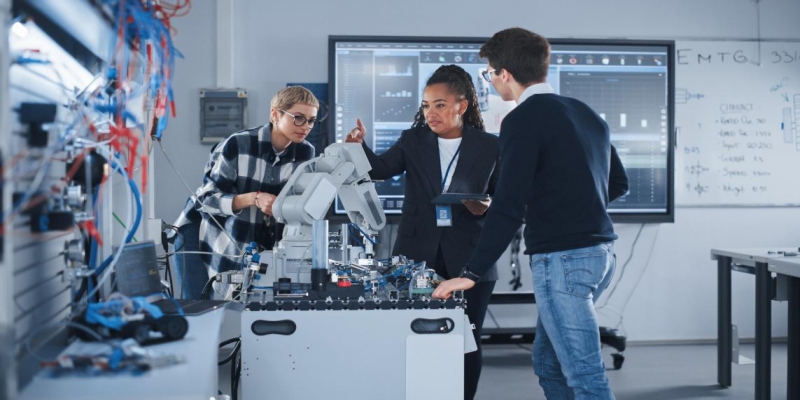
The government has moved to expand funding for industrial automation, positioning digital transformation as a central pillar of economic policy. The initiative builds on existing programmes aimed at modernising production systems and improving efficiency across key sectors, particularly manufacturing and logistics. Officials argue that accelerating automation is essential to address structural weaknesses in productivity.
Recent funding commitments are being channelled through organisations such as Innovate UK, which supports research and collaboration between businesses and academic institutions. These programmes are designed to bring new technologies, including robotics and AI, closer to commercial application, helping firms integrate advanced systems into their operations.
The push reflects growing concern over productivity performance. According to the Office for National Statistics, output per hour has remained below levels seen in several other G7 economies for over a decade. This gap has become a key focus for policymakers seeking to improve long-term economic growth.
Automation is being framed as a solution capable of delivering efficiency gains without increasing labour input. By streamlining production processes and reducing operational costs, firms are expected to improve competitiveness in both domestic and international markets. This is particularly relevant as businesses continue to face rising input costs and global competition.
Funding measures are also targeting smaller businesses, which often face barriers to adopting automation technologies. Grant schemes and advisory support are intended to lower entry costs and provide technical guidance, although access remains uneven across regions and sectors. Industry groups have highlighted the need for more inclusive support mechanisms.
Alongside investment, there is a strong emphasis on research and development. Funding is being directed towards advanced engineering facilities and high-performance computing resources, enabling the development of next-generation automation technologies. This reflects a broader strategy to strengthen the link between innovation and industrial output.
Skills development forms another key component of the policy framework. The expansion of automation is increasing demand for workers with technical expertise, yet employers continue to report shortages in areas such as engineering and data science. Training programmes and apprenticeships are being expanded to address this gap.
However, concerns remain about whether these initiatives will be sufficient to meet demand. Businesses have warned that the pace of technological change is outstripping the development of the workforce, potentially limiting the impact of automation investments. This has led to calls for more coordinated action between industry and education providers.
The policy also comes amid intensifying international competition, with other economies investing heavily in automation and advanced manufacturing. Maintaining competitiveness will depend not only on funding levels but also on how effectively technologies are adopted and scaled across industries.
Despite these challenges, the expansion of funding signals a clear shift towards automation as a long-term economic strategy. By combining investment, innovation and skills development, policymakers aim to create the conditions for sustained growth, although the effectiveness of the approach will depend on implementation in the years ahead.