
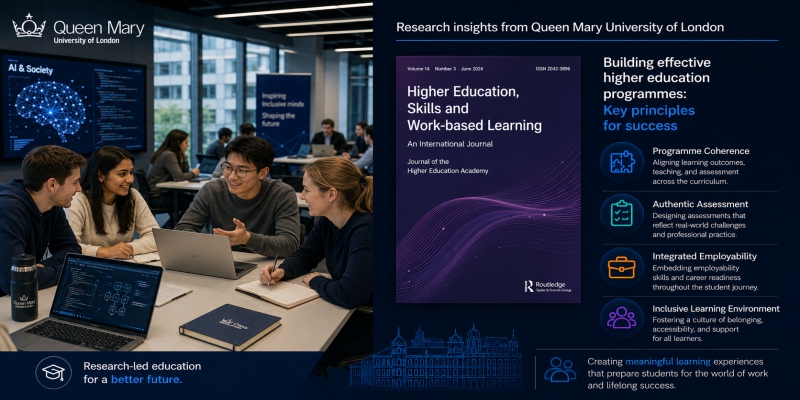
A new academic paper from researchers at Queen Mary University of London is proposing a radical redesign of undergraduate education, blending the best elements of degree apprenticeships with traditional university teaching to create a model fit for the age of artificial intelligence.
Published in the journal Higher Education, Skills and Work-based Learning (May 2026), the research outlines how lessons from a decade of apprenticeship delivery can be used to reshape full-time degrees, with a particular focus on preparing students for a fast-changing, AI-driven workplace.
A decade of insight
Since the UK introduced Degree and Higher-Level Apprenticeships, employers and universities have widely adopted work-based learning to create impactful opportunities for diverse learners. Queen Mary was the first Russell Group university to introduce degree apprenticeships, and after a decade of experience delivering them, there is now valuable, long-term insight that can help improve pedagogy not only for apprenticeships but more broadly across the sector.
The paper, titled Using degree apprenticeships to shape the future of traditional undergraduate degrees, was authored by Ed Macaulay, Jonathan Jackson, Chris White and Adrian Bevan of Queen Mary University of London. It brings together expertise from across pedagogy, work-based learning and curriculum design, combining academic rigour with real-world insight.
A new hybrid model of higher education
At the heart of the research is a bold new idea: the future of undergraduate education lies in combining the strengths of two traditionally separate models.
Degree apprenticeships have long been recognised for integrating academic study with practical, work-based learning and close employer collaboration. Traditional degrees, meanwhile, provide theoretical depth and disciplinary foundations. The paper argues that by merging these approaches, universities can create a new kind of undergraduate programme – one that is academically rigorous, deeply embedded in industry and designed from the ground up for an AI-enabled world.
Industry embedded from day one
A defining feature of the proposed model is its close integration with industry. Rather than treating employability as an outcome at the end of a degree, the approach embeds industry engagement from the very first week.
Students encounter real-world challenges early and continuously, with curricula co-designed alongside employers to ensure relevance and responsiveness to emerging demands for skills. This reflects one of the paper's core pedagogical principles: "integrated employability and industry collaboration", identified as a key lesson from degree apprenticeship delivery.
Rethinking assessment in the age of AI
The research also responds directly to one of the most pressing challenges facing higher education: the impact of generative AI on assessment and academic integrity.
Rather than focusing narrowly on traditional outputs – such as essays that can be easily assisted by AI – the model prioritises:
-
Critical thinking development
-
Authentic, real-world assessment
-
Application of knowledge in context
Authentic assessment, a central principle highlighted in the paper, mirrors workplace practices and makes student thinking more visible, reducing reliance on easily automatable outputs.
This shift is significant. Across the sector, universities are grappling with how to maintain academic standards as AI tools become ubiquitous. By emphasising process, reflection and real-world problem-solving, the model is designed to be inherently more resilient to these challenges.
Eleven tactics, four principles
The paper identifies eleven tactics grouped under four main pedagogical principles:
-
Programme coherence – ensuring a logical and integrated structure across the degree
-
Authentic assessment – mirroring workplace practices and making student thinking visible
-
Integrated employability and industry collaboration – embedding employer engagement from the start
-
Inclusive learning environment – ensuring accessibility and support for diverse learners
The majority of the tactics are found to be directly applicable to non-apprenticeship degree programme design and delivery, with some requiring adaptations.
A testbed for future AI education
The paper uses the example of a new Applied AI undergraduate degree at Queen Mary as a "testing ground" for these ideas. The programme introduces three integrated learning streams: foundations, tools and applications.
Three distinct streams of learning emerged on the new Applied AI degree:
-
Foundations – building theoretical understanding of AI principles
-
Tools – developing practical skills with AI technologies
-
Applications – applying knowledge to real-world problems
The four principles, eleven tactics and three learning streams are proposed as scaffolding for use by other degree programme design teams.
A world-leading collaboration
Led by Queen Mary but developed in collaboration with leading researchers and scholars in education, the paper takes an explicitly interdisciplinary and outward-facing approach. As part of the development process, the team travelled to Silicon Valley to consult with world-leading universities and education experts – including advisers who had previously informed US federal policy – on how institutions are responding to the rise of generative AI.
From outcomes to learning process
A further departure from conventional approaches is a reduced emphasis on predefined outcomes. Instead, the model foregrounds the learning process itself – encouraging curiosity, adaptability and deeper intellectual engagement.
This aligns with wider research suggesting that, in an AI-rich world, education should prioritise skills that are difficult to automate, including creative and analytical thinking.
Implications for the sector
The paper's authors propose that future work should focus on the development of a new apprenticeship standard or subject benchmark statement for Applied AI at undergraduate level.
For universities across the UK, the research offers a practical framework for redesigning degree programmes in response to the AI revolution. The message is clear: the traditional model of undergraduate education – with its separation of academic study from practical application – may no longer be fit for purpose in an AI-enabled world.
As the paper demonstrates, the lessons learned from a decade of degree apprenticeship delivery can help universities create programmes that are academically rigorous, deeply embedded in industry and designed to prepare students for the workplace of tomorrow. For students, that means a university experience that is more relevant, more practical and more closely aligned with the skills employers actually need.