
University applicants without a pass in English GCSE could be barred from accessing government-backed tuition and maintenance loans under plans reportedly being considered by the Department for Education, in a move that critics warn would disproportionately harm students from poorer backgrounds and non-traditional routes into higher education.
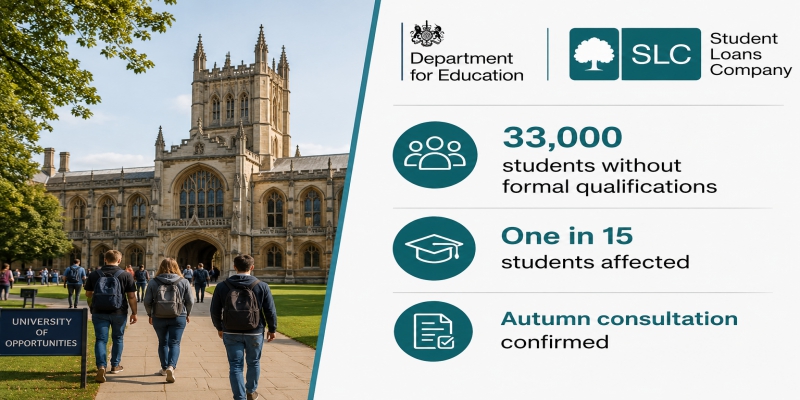
Ministers are understood to be discussing the possibility of making a pass in English GCSE the national threshold for students to access loans through the Student Loans Company. The change would affect more than 30,000 students each year who enrol on full-time first-degree courses without formal qualifications such as GCSEs or A-levels, according to analysis cited by The Guardian. In 2024-25, more than 33,000 domestic students starting full-time first degrees — equivalent to one in 15 — lacked formal qualifications.
Government confirms autumn consultation
The Department for Education has confirmed that it will launch a consultation in the autumn to canvass views on "whether and how the government might introduce a minimum English language requirement for accessing student finance". A DfE spokesperson told The Guardian the department would not comment on speculation but said: "We are restoring our world-class universities as engines of opportunity, aspiration and growth. That is why we are cracking down on poor-quality courses so that students can be confident they're getting value for money from university degrees."
Skills minister Jacqui Smith emphasised the government's determination to tackle poor provision, stating: "Going to university and getting a degree is one of the most transformational things a young person can do. But it is not a universal guarantee of success and not all degrees are equal. As well as the variation by subject, too many franchised and poor-quality courses do not offer a good deal to young people — selling the dream then leaving students in the lurch."
Proposal framed as English language requirement
The proposal has been pitched within Whitehall as an English language requirement, similar to those already required for international students. Currently, only foreign students paying international fees are required to prove their language proficiency, with specific criteria set by individual institutions. There are no national minimum entry standards for domestic students, but ministers are now considering changing this.
However, critics argue that the requirement would serve as a de facto admissions standard by cutting off access to finance, effectively barring students who do not meet the threshold from entering higher education altogether. Under one proposal being discussed, a pass in GCSE English would become the gateway to loan eligibility, functioning similarly to English language requirements already applied to international students.
Universities divided on minimum entry standards
The higher education sector is split on the proposal. The Russell Group of research-intensive universities has voiced support for the introduction of a minimum entry standard, with chief executive Libby Hackett suggesting the change "cannot happen soon enough". Hackett said: "In principle, we support a national minimum entry standard to higher education. Typically, there are minimum entry requirements in place to study A-levels, apprenticeships, many further education courses, and most university courses."
However, Hackett also called for flexibility, emphasising that "crucial to any ongoing discussion will be balancing this with appropriate flexibility for trusted institutions, so they can determine equivalent entry routes for mature students and those from underrepresented backgrounds."
Universities UK, representing 140 institutions, has spoken out against the proposal, warning that it could entrench the disadvantage suffered by poor students. Vivienne Stern, chief executive of Universities UK, called it "really important" for institutions to "determine their own approach to admissions".
Rachel Hewitt, chief executive of the MillionPlus group representing modern universities, questioned the government's rationale: "Universities are autonomous institutions, and if a student can meet their requirements, is willing to take on that investment and is assessed to be capable, MillionPlus questions why the government thinks placing additional barriers in their way is the correct way forward."
Hewitt added: "Universities already have their own checks to ensure learners can meet English language requirements on their courses and will not take on students they are not confident can succeed. Furthermore, this approach risks blocking access to mature students seeking to re-enter education later in life, who are precisely the group the government should want to see reskill and upskill."
Thousands of students at risk
The proposal would have significant implications for institutions that rely on recruiting students without formal qualifications. Several universities, including Bath Spa and Leeds Trinity, admitted more than half of their domestic students without formal qualifications recorded by the Higher Education Statistics Agency in recent years. In many cases, these students are taught through franchise arrangements with private or local colleges, in which universities oversee the courses in return for payment.
The government is also looking at limiting the growth of courses with poorer student outcomes through the revised Teaching Excellence Framework. Universities with significant franchise operations are among those with the highest numbers of domestic students without formal qualifications.
Crackdown on 'low-quality' degrees
The proposals form part of a wider government crackdown on what ministers have described as "low-quality" degrees. Earlier this year, Adam Tickell, the vice-chancellor of the University of Birmingham, called for a review of the academic level at which students are entitled to draw on student loans, saying that those who start degree courses with no formal qualifications required significant investment in "people who…we are not really capable of graduating".
A recent report from the right-wing think-tank Policy Exchange also backed the idea of minimum entry standards, calling for a 30 per cent cut to student numbers in the UK.
However, critics have rejected the proposal, suggesting it would undermine institutional autonomy and penalise students who have taken non-traditional routes into higher education.
Equality impact to be considered
The government has indicated it will carefully consider the equalities impact before making any changes. In a written parliamentary answer on 2 July 2026, ministers stated: "We will be testing how the government should balance robust standards with supporting access and participation for students from different backgrounds and protected characteristics. We are keen to hear views from a wide range of groups and people, and we will carefully consider the equalities impact before making any changes."
The consultation, which will be held in the autumn, will examine options for a minimum English language requirement for accessing student finance. Ministers have not yet confirmed whether the requirement would apply to all courses or whether there would be exemptions for mature students or those with equivalent qualifications.
A defining moment for access to higher education
For tens of thousands of prospective students across England, the outcome of the autumn consultation could determine whether they are able to access higher education at all. The proposal represents one of the most significant shifts in student finance policy in recent years, potentially closing off routes into university for those who have struggled within the school system or who have taken non-traditional paths into education.
The debate also raises fundamental questions about the purpose of higher education and who should have access to it. As the government continues its crackdown on courses it considers to be poor value for money, the challenge will be to ensure that efforts to raise standards do not inadvertently shut out the very students who could benefit most from the transformative power of a university education.