
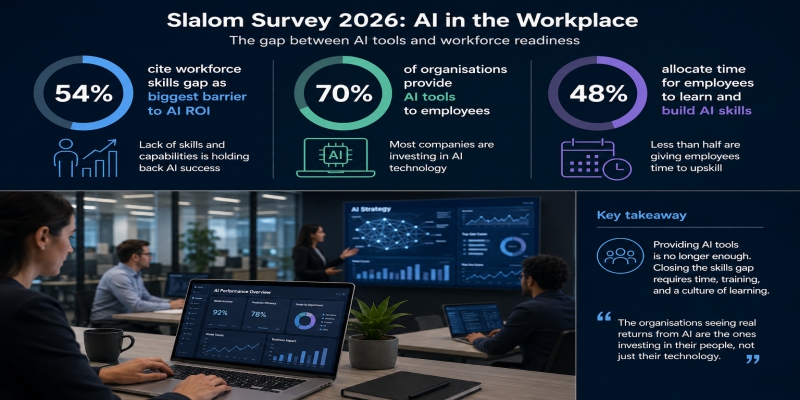
More than half of UK business leaders now view the workforce skills gap as the biggest barrier to achieving a return on investment from artificial intelligence, according to new research that exposes a widening disconnect between AI spending and workforce readiness.
The findings, published by global business and technology consulting company Slalom, reveal that while 70 per cent of UK businesses are giving employees access to AI tools, only 48 per cent are allocating protected time for staff to experiment with them. The research, based on responses from more than 400 business leaders in the UK and Ireland, suggests that many companies have moved beyond deciding whether to invest in AI and are now confronting a workforce capability challenge.
Skills gap emerges as primary barrier to AI returns
The survey found that 54 per cent of respondents identified the workforce skills gap as the biggest obstacle to achieving return on investment from AI. This comes as business leaders face mounting pressure to justify AI spending and demonstrate measurable value from their technology investments.
Earlier findings from the same research project indicate that employees are already feeling the gap. 41 per cent of employees cited a lack of effective, structured AI training or time to learn as the main factor holding them back at work. Employees are explicitly asking for space to understand what AI means for their roles, yet many organisations are moving ahead with tool deployment without that foundational learning period.
Access without adoption: the training gap
The numbers suggest that software access is spreading faster than the time, training and experimentation staff need to use AI effectively in day-to-day work. Nearly all respondents globally worked at companies with revenue above USD $500 million, suggesting the findings reflect larger businesses rather than the wider economy.
Caroline Grant, Senior Managing Director at Slalom UK, said the results showed that investment had moved ahead of workplace readiness.
"This research showed movement in the market, as there is high investment in AI tools for the workforce," Grant said. "Businesses are clearly no longer waiting at the sidelines to see if AI is something they should spend on. Now they are facing a new problem: an AI skills gap. This research shows the UK has yet to do enough to fix this and give employees time to experiment with a technology that could transform the way they work."
Grant added: "Once this adjustment has been made, allowing employees to feel engaged and in control of AI at work, the potential for UK businesses is huge".
The governance risk for employers
There is also a potential governance issue for employers. When staff are expected to increase productivity with AI but are not given formal space to learn, some may turn to unauthorised tools or informal workarounds instead of approved systems. This creates risks around data security, compliance and consistency of use across the organisation.
The imbalance between investment and learning may be especially relevant in larger organisations, where introducing new technology often involves changes to workflow, oversight and staff responsibilities. Without time to explore how tools should be used, employees may be left to fit AI into existing workloads rather than adopt it in a structured way.
Time investment delivers results
One respondent quoted in the findings said setting aside time had been central to making AI useful in practice. The comment came from a company that had already taken that approach with staff.
Shahen Bokhari, AI Product Portfolio Lead at TP ICAP, said: "What stands out in this research is not the level of investment in AI tools, but the lack of protected time for people to actually work out how to use them well."
"At TP ICAP, we made a conscious decision to give colleagues the space to explore, test and challenge how AI could support their day-to-day work," Bokhari said. "That time investment proved critical. It accelerated adoption, built real ownership, and helped us translate technology into tangible business benefits."
The lesson is straightforward: tools alone do not generate returns. People need time to work out how to use them well.
The broader skills landscape
The Slalom findings add to a growing body of evidence that skills shortages are holding back AI adoption across the UK economy. Government research published in January 2026 found that 57 per cent of businesses reported a technical skills gap in the AI labour market, while 30 per cent reported a non-technical skills gap.
Separate research from the Management Consultancies Association, published earlier this month, found that 45 per cent of public sector respondents cited skills shortages as a significant barrier to greater adoption of AI, compared to 32 per cent of their private sector counterparts.
A workforce issue as much as a digital one
For HR leaders, the findings highlight an important challenge. AI adoption cannot be treated simply as a technology deployment. If employees are expected to generate value from AI, organisations need to give them the time, guidance and confidence to understand how these tools apply to their roles.
As pressure increases on leadership teams to demonstrate measurable value from AI, the absence of protected learning time may become a significant obstacle. Without it, AI tools risk remaining underused, poorly understood or limited to basic tasks rather than becoming meaningful drivers of productivity and innovation.
The findings reflect a wider shift taking place across the workplace. Organisations are moving quickly to adopt AI, often driven by the need to improve efficiency, competitiveness and decision-making. However, employees are still working through what AI means for their roles, their skills and their future career relevance.
What needs to change
The research suggests that businesses need to shift their thinking from simply providing access to AI tools to actively creating the conditions for effective adoption. This means allocating protected learning time, providing structured training programmes, and giving employees the space to experiment and build confidence with AI tools.
For HR teams, this places AI readiness firmly within their remit. HR leaders will need to work closely with business and technology leaders to ensure AI rollout plans include learning time, role-specific training and clear communication. Employees are more likely to engage with AI when they understand why it is being introduced, how it applies to their work and what support is available.
The message from the research is clear: organisations spending on AI tools without investing in employee time and training risk wasting money. The fix is not complex, but it does require deliberate action. As Grant put it: "If organisations want to close the gap between AI ambition and AI return, giving people time, not just tools, has to be part of the equation".