OVERVIEW
Studying CYBERSECURITY in the UK
Cyber security is a critical and fast-evolving profession that focuses on protecting digital systems, networks, data and infrastructure from unauthorised access, damage, disruption or theft. In today’s interconnected world where individuals, organisations and governments increasingly rely on digital platforms for business, communication, finance and public services safeguarding digital assets has become a fundamental priority.
Cyber security professionals deploy technical skills and strategic thinking to prevent, detect and mitigate cyber threats such as malware, phishing, ransomware, denial-of-service attacks and advanced persistent threats. Their work spans security architecture design, network defence, incident response, forensics, vulnerability assessment and compliance with legal and regulatory standards.
In the UK, the demand for cyber expertise cuts across sectors from financial services, healthcare and government to telecommunications, manufacturing and defence making it one of the most interdisciplinary and globally relevant careers in technology. Cyber security roles blend deep technical understanding with risk management, policy interpretation and a strong ethical foundation, enabling professionals to defend vital systems against increasingly sophisticated threat actors.
✓
HOW WE RANK
Methodology and ranking criteria
Our ranking considers academic quality, specialist expertise, course choice, institutional reputation and the opportunities available to postgraduate students. It is designed to help you compare leading UK institutions and identify the option that best matches your goals.
THE RANKING
Top institutions for CYBERSECURITY
4 institutions
#1
The University of Glasgow, founded in 1451, is one of the oldest universities in the English-speaking world. Located in Glasgow, Scotland, it is a public research institution renowned for its strong academic tradition and its broad range of disciplines including the arts, sciences, medicine, engineering, and social sciences. Its main campus lies at University Avenue in the West End of Glasgow, and it operates additional facilities including a campus in Dumfries.
Glasgow is committed to excellence in teaching and research, with a vibrant international student community and extensive partnerships globally. The university offers undergraduate, postgraduate and doctoral programs, with comprehensive support services, modern facilities and a focus on innovation, societal impact and cross-disciplinary collaboration.
#2
Leeds Beckett University is a public university located in Leeds, in the county of West Yorkshire, England. The institution traces its origins back to 1824 and gained university status in 1992. It is known for its strong emphasis on professional education, applied research and close collaboration with industry partners across a variety of sectors.
The university offers undergraduate and postgraduate programmes in areas such as Business, Sport, Health, Engineering, Creative Arts and the Social Sciences. With campuses located in the city centre and at Headingley, Leeds Beckett provides modern facilities, industry-focused teaching and a learning environment designed to support both academic development and employability.
#3
Sheffield Hallam University (SHU) is a public research university located in Sheffield, South Yorkshire, England. Established in its origins in 1843 and gaining full university status in 1992, SHU comprises two main campuses: the City Campus (in the heart of Sheffield) and the Collegiate Campus (around two miles away in the Broomhall / Ecclesall Road area).
The university offers a wide variety of undergraduate, postgraduate, and research programmes across multiple fields including arts, engineering, health sciences, business, computing, and social sciences.
#4
The Open University is a public research university in the United Kingdom specialising in distance learning and flexible education. Founded in 1969, it was established to widen access to higher education by enabling students to study remotely regardless of location, prior qualifications or personal circumstances. The university has since become one of the largest higher education institutions in Europe in terms of student enrolment.
The institution offers a wide range of undergraduate and postgraduate programmes across disciplines including Business, Education, Computing, Social Sciences, Psychology and Engineering. Its teaching model combines online learning platforms, tutor support and independent study materials, allowing students to balance their studies with professional and personal commitments.
✅ Trends and Employment
Skills Gaps, Demand Pressures and Workforce Trends
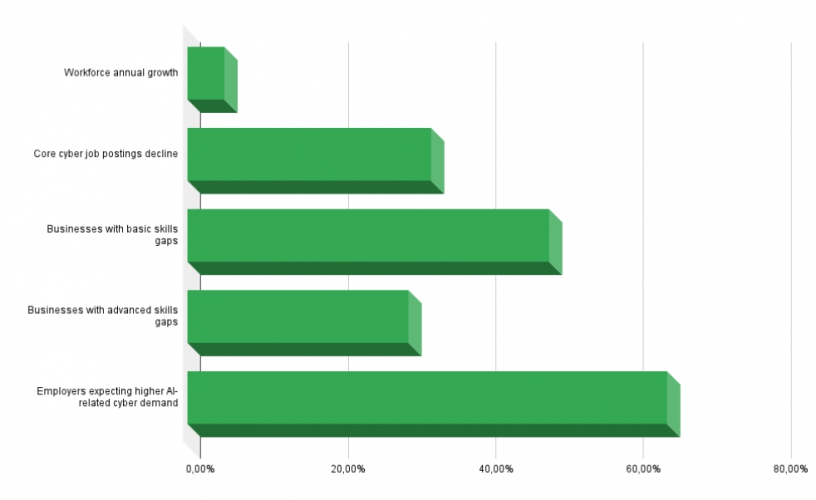
This pie chart highlights the key structural pressures shaping the UK cyber security labour market. While the workforce continues to grow at a moderate annual rate of 5%, the data reveals a clear imbalance between supply and demand. A significant 49% of UK businesses report basic cyber skills gaps, and 30% identify shortages in advanced technical capabilities, such as threat analysis, incident response and secure systems design. These figures indicate that, despite steady workforce growth, many organisations struggle to recruit professionals with the depth of expertise required to manage increasingly complex cyber threats.
At the same time, the chart reflects shifting dynamics in employer demand. Although core cyber security job postings have declined by 33%, largely due to broader economic conditions, expectations around emerging technologies remain strong. Notably, 65% of employers anticipate increased demand for AI-related cyber security skills, signalling a strategic pivot towards automation, machine learning and advanced analytics in security operations. Together, these indicators suggest that the UK cyber security sector is moving towards higher specialisation, where professionals with advanced and AI-enabled skills are likely to face stronger long-term employment prospects despite short-term fluctuations in overall hiring activity.


