OVERVIEW
Studying FINANCE in the UK
Economics is a social science that focuses on understanding how societies use limited resources to produce goods and services and distribute them among individuals and organisations. At its core, the profession involves analysing data, developing models, and interpreting trends to explain and predict economic behaviour at microeconomic and macroeconomic levels.
Economists study the forces that drive economic growth, inflation, unemployment, consumer behaviour, financial markets and public policy, helping to inform decisions made by governments, businesses, financial institutions and international organisations.
The profession blends theoretical frameworks with empirical evidence; practitioners typically apply statistical methods and econometric tools to large datasets, enabling them to evaluate economic outcomes and provide evidence-based recommendations.
Economics is a respected and influential field, with applications ranging from public policy analysis and fiscal forecasting to corporate strategy, environmental economics and international trade.
Their work might involve writing economic reports, forecasting trends, assessing the impacts of taxation or regulation, advising on investment strategies or analysing labour market dynamics.
Economists play a crucial role in shaping public understanding of economic issues and in guiding policymakers; for example, during periods of economic uncertainty they evaluate fiscal and monetary interventions to support employment and stabilise inflation.
✓
HOW WE RANK
Methodology and ranking criteria
Our ranking considers academic quality, specialist expertise, course choice, institutional reputation and the opportunities available to postgraduate students. It is designed to help you compare leading UK institutions and identify the option that best matches your goals.
THE RANKING
Top institutions for FINANCE
7 institutions
#1
The University of Bath is a prestigious public research university located in Bath, in the county of Somerset, England. It was granted its Royal Charter in 1966, evolving from earlier institutions such as the Bristol College of Science and Technology. Its modernist campus is situated on Claverton Down, about 1.5 miles from the heart of the city. The architectural layout is designed to separate vehicular traffic from pedestrian pathways, with academic and residential buildings aligned along a central thoroughfare known as ¿the Parade.¿
Bath is widely recognised for its strong emphasis on research, academic rigour, and student experience. It offers a diverse array of undergraduate and postgraduate programmes across disciplines such as engineering, science, humanities, and social sciences. The university maintains high standards through industry partnerships, excellent employability outcomes for graduates, well-equipped facilities and an active international community. Its integration of modern facilities and scenic surroundings adds to its appeal both for domestic and international students.
#2
The University of Cambridge is a public collegiate research university located in Cambridge, in the county of Cambridgeshire, England. It was founded in 1209, when scholars left Oxford after disputes and established a new centre of learning in Cambridge. The university was formally recognized by King Henry III in 1231 with a royal charter.
Over the centuries, Cambridge has grown to consist of 31 semi-autonomous colleges and more than 150 faculties, departments, and other institutions, grouped into six schools. All students are members of a college, which plays a central role in their academic, social, and pastoral life.
The university is renowned internationally for its academic and research excellence. It has produced many notable alumni, including Isaac Newton, Stephen Hawking, Charles Darwin, and John Maynard Keynes, among others.
Cambridge¿s contributions span numerous fields¿from mathematics and physics to the humanities¿and many of its buildings, libraries, and museums are of significant historical and architectural importance. The Fitzwilliam Museum, for example, houses a vast collection of art and antiquities; the New Museums Site has been central to scientific discovery; and King¿s College Chapel is one of its iconic architectural landmarks.
#3
Imperial College London is a leading public research university located in London, England, established by Royal Charter in 1907. It specialises in science, engineering, medicine, and business, with a strong international reputation for cutting-edge research and innovation. Its main campus is in South Kensington, where many of its faculties, laboratories, and lecture theatres are based, with additional facilities at locations such as White City.
The university is renowned for its rigorous academic programmes, selective admissions, and impactful contributions to global scientific knowledge. Imperial has produced Nobel laureates, pioneering researchers, and innovations across multiple disciplines. Students benefit from small-group teaching, extensive links with industry, and access to state-of-the-art research infrastructure.
#4
The University of Oxford is a renowned public collegiate research university situated in Oxford, England. Founded in the 12th century, it is the oldest university in the English-speaking world. The university is composed of numerous colleges and halls, each with its own identity, governance, and responsibilities for admitting students, welfare, and accommodation.
The academic structure is organized into departments and faculties that conduct teaching and research across a broad range of disciplines. Oxford is not a campus-based university; its colleges, libraries, departments and other facilities are distributed throughout the city
#5
The University of Dundee is a public research university located in the city of Dundee, in Scotland, United Kingdom. It acquired its independent university status by Royal Charter in 1967, building on its earlier foundation as University College in 1881, which was itself part of the University of St Andrews.
Its main campus is situated in the West End of Dundee, with additional facilities at Ninewells Hospital (for medical and health sciences) and in Kirkcaldy, Fife (for nursing and midwifery).
#6
The University of Birmingham is a prestigious public research university located in Edgbaston, Birmingham, England. It was granted its Royal Charter in 1900, and since then has become one of the UK¿s leading universities, belonging to the Russell Group of research-intensive institutions.
Its main campus spreads over 250 acres, combining historic architecture (such as the Joseph Chamberlain Memorial Clock Tower, also known as ¿Old Joe¿) with modern facilities. The University offers a wide range of undergraduate, postgraduate, and doctoral programmes across diverse disciplines including arts, sciences, engineering, medicine, and social sciences.
#7
The University of Glasgow, founded in 1451, is one of the oldest universities in the English-speaking world. Located in Glasgow, Scotland, it is a public research institution renowned for its strong academic tradition and its broad range of disciplines including the arts, sciences, medicine, engineering, and social sciences. Its main campus lies at University Avenue in the West End of Glasgow, and it operates additional facilities including a campus in Dumfries.
Glasgow is committed to excellence in teaching and research, with a vibrant international student community and extensive partnerships globally. The university offers undergraduate, postgraduate and doctoral programs, with comprehensive support services, modern facilities and a focus on innovation, societal impact and cross-disciplinary collaboration.
✅ Trends and Employment
Employment Strength, Wage Growth and Hiring Slowdown
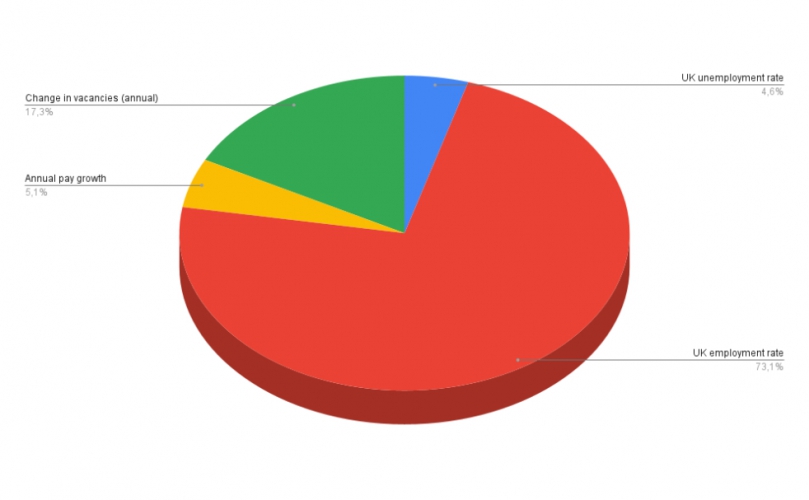
The UK employment rate (75.2%) clearly dominates the distribution, indicating that a strong majority of the working-age population (16–64) remains in employment. In contrast, the unemployment rate (4.7%) represents a relatively small share, suggesting that overall joblessness is still contained despite recent economic pressures. These figures reflect a labour market that remains broadly resilient, even as growth has moderated.
Alongside employment levels, the chart also captures important demand-side signals. Annual pay growth (5.2%) shows that wages continue to rise, partly compensating for inflation and cost-of-living pressures faced by households. However, the annual change in vacancies (-17.8%) points to a notable contraction in hiring activity, indicating that employers are becoming more cautious about creating new roles. Taken together, these indicators suggest a UK labour market that is still strong in terms of employment and earnings, but increasingly characterised by slower recruitment and reduced job openings.