OVERVIEW
Studying MARKETING in the UK
Marketing is a dynamic and multifaceted profession that plays a central role in how organisations understand, engage with and influence their customers. At its core, marketing involves identifying customer needs, analysing market trends, developing strategies to reach target audiences, and creating compelling messages that drive consumer behaviour.
This discipline draws on psychology, economics, data analysis, design and communication, requiring professionals to blend creativity with analytical thinking. Modern marketing spans a broad range of activities, from digital and social media campaigns to brand management, market research, product development and customer experience optimisation.
With the rise of technology, marketing teams increasingly integrate data-driven insights and digital tools to measure performance, personalise content and refine strategies in real time.
In the UK, marketing professionals find opportunities across nearly every sector of the economy, including retail, technology, finance, media, healthcare and public services. Whether working for multinational corporations, specialist marketing agencies, start-ups or non-profit organisations, marketers are responsible for shaping brand narratives and driving business growth.
Entry into the profession can begin at various levels from graduate marketing assistant or junior digital marketer roles to specialised fields such as SEO, content strategy and analytics.
✓
HOW WE RANK
Methodology and ranking criteria
Our ranking considers academic quality, specialist expertise, course choice, institutional reputation and the opportunities available to postgraduate students. It is designed to help you compare leading UK institutions and identify the option that best matches your goals.
THE RANKING
Top institutions for MARKETING
5 institutions
#1
The University of Dundee is a public research university located in the city of Dundee, in Scotland, United Kingdom. It acquired its independent university status by Royal Charter in 1967, building on its earlier foundation as University College in 1881, which was itself part of the University of St Andrews.
Its main campus is situated in the West End of Dundee, with additional facilities at Ninewells Hospital (for medical and health sciences) and in Kirkcaldy, Fife (for nursing and midwifery).
#2
This Marketing programme equips students with the critical and creative skills required to succeed in a rapidly evolving global marketplace. Through a blend of theoretical frameworks, case studies, and hands-on projects, learners explore brand strategy, market research, consumer insights, and digital innovation. Students also gain exposure to cutting-edge topics such as sustainability in marketing, artificial intelligence applications, and cross-cultural communication strategies. Industry placements and live consultancy projects ensure that graduates are prepared to tackle real-world challenges with confidence. By combining strategic thinking, analytical skills, and creativity, the programme prepares participants for diverse roles in advertising, digital media, brand management, and beyond, ensuring long-term career success in a competitive sector.
#3
The University of Oxford is a renowned public collegiate research university situated in Oxford, England. Founded in the 12th century, it is the oldest university in the English-speaking world. The university is composed of numerous colleges and halls, each with its own identity, governance, and responsibilities for admitting students, welfare, and accommodation.
The academic structure is organized into departments and faculties that conduct teaching and research across a broad range of disciplines. Oxford is not a campus-based university; its colleges, libraries, departments and other facilities are distributed throughout the city
#4
The University of Cambridge is a public collegiate research university located in Cambridge, in the county of Cambridgeshire, England. It was founded in 1209, when scholars left Oxford after disputes and established a new centre of learning in Cambridge. The university was formally recognized by King Henry III in 1231 with a royal charter.
Over the centuries, Cambridge has grown to consist of 31 semi-autonomous colleges and more than 150 faculties, departments, and other institutions, grouped into six schools. All students are members of a college, which plays a central role in their academic, social, and pastoral life.
The university is renowned internationally for its academic and research excellence. It has produced many notable alumni, including Isaac Newton, Stephen Hawking, Charles Darwin, and John Maynard Keynes, among others.
Cambridge¿s contributions span numerous fields¿from mathematics and physics to the humanities¿and many of its buildings, libraries, and museums are of significant historical and architectural importance. The Fitzwilliam Museum, for example, houses a vast collection of art and antiquities; the New Museums Site has been central to scientific discovery; and King¿s College Chapel is one of its iconic architectural landmarks.
#5
The University of Bath is a prestigious public research university located in Bath, in the county of Somerset, England. It was granted its Royal Charter in 1966, evolving from earlier institutions such as the Bristol College of Science and Technology. Its modernist campus is situated on Claverton Down, about 1.5 miles from the heart of the city. The architectural layout is designed to separate vehicular traffic from pedestrian pathways, with academic and residential buildings aligned along a central thoroughfare known as ¿the Parade.¿
Bath is widely recognised for its strong emphasis on research, academic rigour, and student experience. It offers a diverse array of undergraduate and postgraduate programmes across disciplines such as engineering, science, humanities, and social sciences. The university maintains high standards through industry partnerships, excellent employability outcomes for graduates, well-equipped facilities and an active international community. Its integration of modern facilities and scenic surroundings adds to its appeal both for domestic and international students.
✅ Trends and Employment
UK Marketing Employment Landscape: Workforce Sentiment and Market Pressures
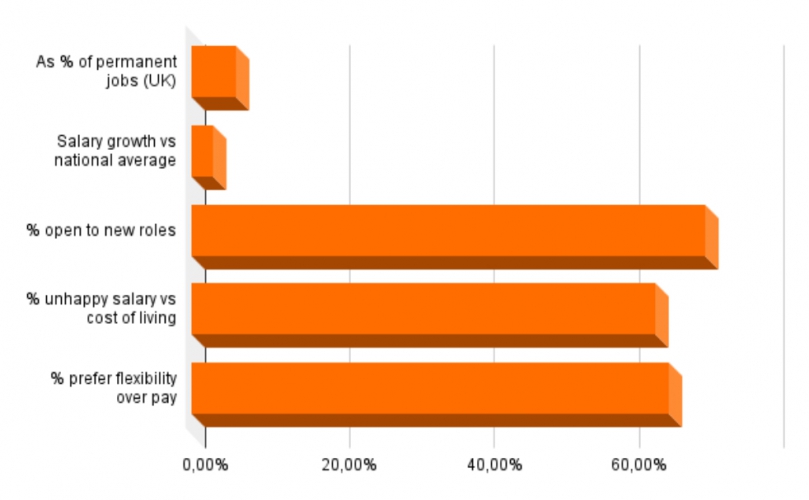
While marketing roles account for a solid share of permanent job opportunities (6.04%), salary growth in the sector remains relatively modest at 3% compared with the national average. This imbalance highlights a labour market where demand for marketing skills persists, but financial progression has not fully kept pace with broader economic conditions.
At the same time, workforce sentiment reveals significant structural pressures. A high proportion of marketing professionals are open to new roles (71%), and a majority report dissatisfaction with their salary in relation to the cost of living (64%). Additionally, 66% indicate a preference for flexible working arrangements over higher pay, underlining a shift in priorities towards work–life balance.